Agentic risk management
Redefining how Meta respond to new laws, policies, and emerging risks at scale.

Role
Lead Product Designer
Timeline
February — March 2026
2 months
Team
1 PD, 1 PM, 1 UXR, 4 engineers
Skills
Agentic Interaction Design · Product Strategy · Systems Design
Overview
What changes when AI becomes part of a high-stakes workflow?
I redesigned how Meta's risk teams create and update compliance requirements, replacing a rigid, multi-page wizard with an agent that clarifies intent conversationally and routes each change to the surface its complexity requires.
At a glance
Challenge
Risk compliance changes at Meta took 5.8 days on average, needed dedicated support 56% of the time, and caused 18 downstream misconfigurations, because every request followed the same rigid workflow.
My approach
I redefined how changes move through the system, replacing a rigid wizard with an experience that adapts based on the type of change and its downstream impact.
Impact
Within 14 days of GA, 67% of published requests used the agentic workflow, with 5× faster median completion and no reported increase in downstream misconfigurations.
Why this mattered
The system treated every change the same.
Every change, from a one-line tweak to a company-wide policy shift, went through the same rigid process, so the system's inflexibility became the real bottleneck as compliance pressure grew. The experience needed to match the impact of the change.
Feedback & Support group and one of our engineers will get back to you.
writing requirements
asset types: X, Y".
Jurisdiction, Semantic Type, etc.
Controls Manager Feedback & Support group and one of our engineers will get back to you.
What's at stake
Safety
Manual workflows increase the likelihood of misconfigurations and inconsistent enforcement.
Speed
High-friction workflows slow policy execution and consume specialized engineering capacity for routine work.
Scale
When teams bypass the platform, governance moves into spreadsheets and tribal knowledge, weakening the system as the source of truth.
Solution
01 · Interaction model
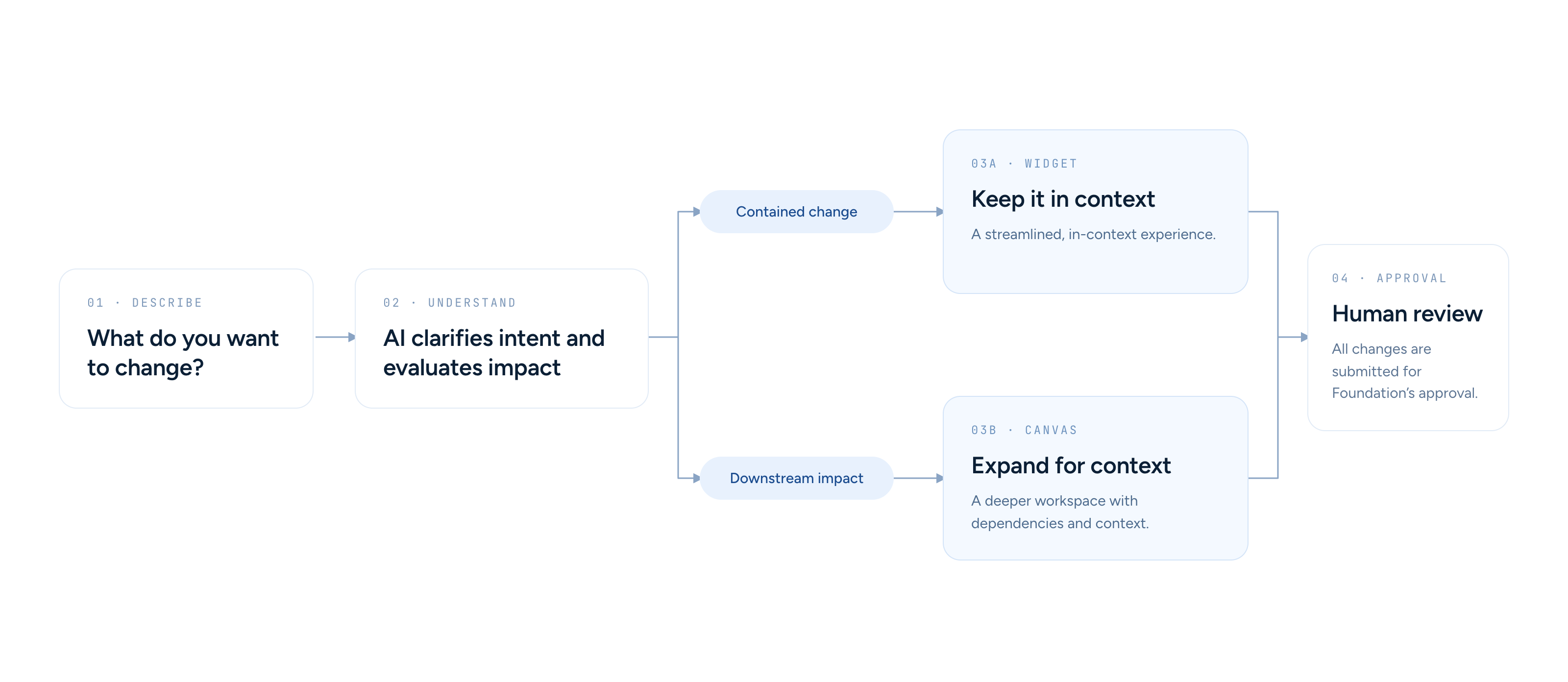
An experience that adapts to what's changing.
02
Architecting the agentic experience
Part of my work was stepping back from this one system and aligning with Meta's broader risk org on the standards that would govern AI use across teams.
03
Full-screen conversation
Every task starts as a conversation that clarifies intent before deciding where it needs to go.
04
Widget injection
Self-contained changes resolve directly inside the conversation, giving users only the controls necessary to review, modify, and submit the proposed change.
05
Canvas mode
When a change carries downstream implications, the experience expands into Canvas Mode, exposing dependencies, affected objects, and the context required to understand the consequences before submission.
Reflection
The system outgrew the problem
Build reusable components and primitives that other teams could extend without rebuilding from scratch.
Autonomy needs clear boundaries
Be explicit about where the agent acts and where human judgment remains.